Photobucket Photobucket Photobucket

Monday, 16 December 2013

To virginity and beyond...

I’ve got a complicated relationship with the name of this blog, ‘Notes To Virgins’. I started it to provide intelligent sex education for adults, as I’ve always been ridiculously disappointed with the lack of quality, honest and practical information provided by schools and health services to young people when they really need it. I have convos with people every day about their sex lives, and I’ve almost stopped being surprised by the amount of mis-information people are fed by schools, their parents, friends, the media & porn.  So, in essence, I wanted this blog to be able to counter-act that and maybe be able to help some people have better sex lives, with themselves and others. But the name has caused me some torment.
 
‘Notes to virgins’ can be read as being just for those who haven’t had sex/ screwed/fucked/popped their cherry/etc etc etc. But it’s so much more. It’s about doing things you haven’t done before. About broadening the horizons of your sexual experiences. About re-learning all that bullshit we’re taught from a young age. And one of those bullshit things is about the supposedly clear-cut distinction of virginity.

 
Virginity has got a whole load of social and cultural value. When/where women were sold and traded, virginity added a stack of value, but as we know, it’s the opposite for men (I’m talking American Pie-style message of virginity as something to get rid of as quickly and easily as humanly possible. Like some kind of sticky and awkward hot potato). So what even is virginity? What is this magical transition that happens the first time you have someone put something (obviously preferably a penis, according to common definition of sex) inside you, or the first time you put your penis into someone? What is it that you lose when you ‘lose your virginity’?
 
I’d like to argue that we don’t lose anything – not a hymen, not purity, not innocence, not value. What if we actually gain something? What if having sex for the first time can be thought of as a stage of development, a growing experience, a whole new level of knowing yourself, and others.  
 
Now that all sounds a bit deep and meaningful, but seriously, what if we starting looking at virginity differently, and naming it differently. What if we called it ‘gaining sexual maturity’. What if we called having sex for the first time (in whatever way you want to define it – make your own damn rules) your ‘sexual debut’ (a word commonly used in health promotion and sex research). That’s awesome, hey? “I made my sexual debut”. Sounds like it could be accompanied by some kind of awesome party. Or a gold record mounted in a frame. Or at least a badge. A full discussion about the political and feminist meaning of this is beyond the scope of this blog-post (and, to be honest, my expertise and writing skills) but, suffice to say, regardless of what we call it, we need to start embracing opportunities to define (and re-define) our sex lives and our sexuality.
 
So back to my point – why did I call this blog, ‘Notes to Virgins’? Not because I wanted it to be read only by those who hadn’t yet become sexually active. But because I see sex throughout the life as a constant process of learning, no matter how many times or with how many different people you’ve had ‘sex’. It changes with different partners, different bodies (yep. Your own body will surprise you with its changes), different times and emotions, different relationships. So, in essence, every time we have sex we are virgins going into it, regardless of how ‘routine’ or ‘common’ it may seem.
 
And what does this mean for you? It means I’d like you to try to take each sexual experience as a new opportunity to learn, about your own body, about the body of your partner(s) and their sexual response, about the way you are TOGETHER, about how you feel before/during/after, about what you like and don’t like. And if you still feel like you’re losing something the first or any time you have sex, you’re doing it wrong. Take some time off, find yourself, find a different partner, and find a satisfying sex life which allows you to grow. I reckon that’s what it’s all about. That’s where awesome sex (and sex education) comes from - where ‘virginity’ becomes irrelevant and meaningless.


p.s - I promise my next post will be back to the good old fashioned  here's-how-to-have-amazing-sex format.

Tuesday, 19 November 2013

Quick(y) Update

I have to send out a whole lot of apologies for not updating Notes To Virgins recently. I have been writing for Cosmopolitan Australia Magazine, new women's website My Little Black Book, and contributing to some friend's articles in other mags aswell. On top of that, I have just secured a job on the Youth Sexual Health team at Family Planning NSW, so it's all happening!

As part of my work with My Little Black Book, they are offering my blog readers an amazing deal on their products with 10% off all purchases - see off to the RIGHT hand side of my blog and click the little ad for more information. They have an amazing range of quality products which I whole heartedly endorse - get your hands on some, ASAP!

Check out a couple of my latest articles here:
'Help! My boyfriend's penis is too big!' (Australian Women's Health & Fitness)
'Size Matters: How to make the most out of his package' (MLBB)
Also check out the monthly Cosmo mag for my regular articles (December I talk about the differences between men & women in terms of sex, and next month my article about Porn Sex VS Real Sex will be up. I'm also going to be in 'Cosmo Campus' early next year discussing the dos & donts of dorm sex)

Coming up in my next post I want to explore the idea of 'virginity' and what it actually means - should we be even using the term 'virginity' or 'losing your virginity' anymore? Does penetrative intercourse actually constitute a 'sexual debut' or should this concept be more open to encompassing a range of sexual behaviours and interactions? What does this mean for GLBTI communities and those who are non-heteronormative in their relationships and sex lives?

I'm also keen to know what YOU would like me to write about - do you have any questions about sex? What do you wish you were taught about in sex ed but weren't? What saucy questions would you like answered!? Comment below & let me know xx

Friday, 9 August 2013

The Red Bedding: Sex During Menstruation

SIDENOTE: If you don't get the Game of Thrones reference in that title, you should be ashamed. 


There's a point in every relationship where the topic of sex during menstruation comes up. Usually it's when you've planned a sexy long weekend away, or you've got the house to yourselves, and you're both incredibly horny. Those moments where you're both really keen to make the most of it, but it's something you've never discussed.... do you take the plunge in sex during menstruation or not?

Friday, 28 June 2013

Pap Fear

There's a few things I'm afraid of, including cancer, unemployment & water slides (don't even get me started). The mere prospect of any of these things happening to me (yes, the idea of going to a water park sends me into a frenzy) makes my palms sweaty, knees weak, arms are heavy. There's vomit on his sweater already, mom's spaghetti. Okay, I got a bit carried away there with the Eminem lyrics. But seriously, we have an anxiety response to things we're afraid of. Our heart races, we sweat, we find it harder to breathe and we tense up (and, if you're Eminem, you spew on yourself and crave homemade Italian).

This is the response a lot of women have when they think about getting a pap smear. Coupled with the shear embarassment of getting your bits out for a random, there's a few big reasons why many women don't get their pap smears as regularly as they should.

The NSW Cervical Screening Program recommends all women between the ages of 18 and 70 years and who have ever had sexual intercourse should have a Pap test every two years. I was recently taught how to conduct a pap smear (practicing on a pelvic dummy, ofcourse) which was an amazing experience, so wanted to share some insights with you -


SO WHY DO WE FEAR THE SMEAR?

We don't know what to expect - let's be honest: the speculum (aka the 'duck bill') is a pretty terrifying-looking device. But in reality, it's actually not too bad, and serves a very important purpose. Rather than a sharp pain, most women report more of a firm pushing against the muscles of the vagina and some discomfort. If you're experiencing too much pain or discomfort, tell the person performing the pap smear. Don't be silent!

Some women don't really know what the doctor or nurse is doing down there or what they're testing for. We're never told what actually happens during a pap smear, so, let's lay it out. Pap smears basically check for any abnormal cervical cells which could develop into cancer - so better to get them early. It doesn't check for any other reproductive abnormalities, or sexually transmissible infections, and you will still need them even if you've had the HPV vaccine. The (thoroughly lubed) speculum is inserted into the vagina and is opened slightly, allowing the doctor or nurse to get a sample of cervical cells by gently swabbing a soft brush or similar against the cervix. This is then withdrawn, followed by the speculum. Sometimes they'll do a pelvic examination by inserting their fingers into the vagina and pushing their hand on the outside of your pelvis. Otherwise, that's it! You're done!

We are embarrassed about our own bodies - any time we have to get our clothes off for medical professionals, a lot of us have those circling thoughts - "will they think my vagina is weird?", "I forgot to wax...they'll think I'm gross" or "what if it smells?!". In reality, this is what doctors and nurses are trained to do. They've seen, heard & smelt it all, so don't be embarrassed to get your kit off. If there truly is a physical issue, they are the ones who'll be able to help you address it - so it's a win-win situation!

We think that it will hurt - When we expect pain, our vaginal muscles will tighten, which can make any penetration painful. We prepare ourselves for pain, which actually increases the chances that we will  experience pain. Massive catch 22! The average speculum is approximately 2 - 3cm wide, meaning that it's about as big as two fingers. If you feel comfortable, practice inserting a couple of fingers into your vagina and breathe deeply throughout. This will get you used to the sensation and ways to work through it.

We are scared of the results - Lots of women avoid getting pap smears for the reason we avoid getting other sorts of tests. We don't think we're at risk, or we don't want to know the results if it means bad news. We think that if we don't put ourselves in the situation of getting tested, then we can just put our heads in the sand and stay safe. But the reality is that early diagnosis is much better than late diagnosis, so keep on top of it regularly to make sure you keep yourself healthy.


TIPS TO MAKE THE PAP BEARABLE:


Go somewhere you know they do a lot of pap smears - Family Planning and sexual health centres are your best options. They do a vag-load of pap smears, and will not be shocked by anything. They are usually covered by the healthcare system, so if you have a Medicare card/number, take it along with you.

Relax and breathe deeply  - Learn to focus on your breathing, and make sure it's deep and regular. This will help to calm you both physically and mentally, which will help your vaginal muscles to relax and give the speculum a smooth and painless entrance.

Ask the nurse or doctor to talk you through what they're doing. They will probably do this as part of good practice anyway, but ask them to talk through each step of the process during the test. It will make you more aware of what's going on, able to tune into your body, and not shocked by any unexpected touches or movements.

Pop them pills: Take a few panadol/nurofen an hour or so before you go in. Just like the tactic for anyone's first tattoo, it will make it slightly less uncomfortable and will probably put your mind at ease a little too.

and remember, don't have sex for 24 hours before your pap smear, as it may mean the results are hard to read and you'll have to get a second examination!


Thursday, 30 May 2013

Orgasm Anxiety

I've been writing a contribution for an upcoming issue of Cosmopolitan magazine, and thought it was an important issue to address on my blog in a more extended form. The female orgasm has been subject to a great deal of discussion, and a lot of us ladies feel a great deal of pressure to be orgasmic, multi-orgasmic, squeelers, squirters, g-spotters, or mutually orgasmic (with our partners). The reality is, a lot of women aren't orgasmic at all, or can only reach the big O under certain circumstances. There's a lot of stress and anxiety around female pleasure and orgasm, so it's time to break down some of them.

I get a lot of questions from women about orgasms, so I thought I'd look at a few of the more common ones here.

What do orgasms feel like? How do I know if I've had one?


Some words commonly used terms to describe female orgasm are: warm, tingly, shaking, contractions, like you have to pee, a sense of release. While some people say "you'll know when you've had one", I think this sets up an expectation of women to both be in touch with their bodies and to have noticeably intense orgasms. Each person will experience orgasm slightly differently. Most women will make some vocalisations when they are reaching orgasm, and experience involuntary muscle contractions (including the classic 'curling toes'). However, don't think you're going to have a Hollywood bed-head-shattering scream-fest.  Thanks to rom coms and porn we think all orgasms are explosive, but you may find it is much less intense than you expect.

It's also common for the clitoris to be particularly sensitive after orgasm, although women are lucky enough to be able to experience multiple orgasms, so with continued stimulation another orgasm may follow.

Some women (approximately 6-13%) may 'squirt' when they orgasm, meaning they experience a type of female ejaculation where they expel or spray liquid from their vagina during climax (also known as 'gushing'). The jury is still out on what the liquid is, but it appears to be a mixture of vaginal lubrication and a liquid from the female prostate (or 'Skene's gland'). I'll write a longer blog post specifically about female ejaculation at a later date, but the main point to note here is that it is not urine which is ejaculated (although it may contain some urine substance), the amounts can vary from a few droplets, to quite a saturating amount, and don't be afraid of it! It's completely normal even though it's not experienced by most women - so you're one of the special few!!

(source: http://alfredo.octavio.net/2005/07/08.html)

The bottom line is, there's a whole range of experiences and it's quite difficult for me to say whether anyone has had an orgasm or not. Suffice to say, if you feel a build-up, followed by pleasure and release (and possibly clitoral sensitivity), I would suggest you have probably had an orgasm. If not, there's plenty of time to keep experimenting by yourself and/or with a partner(s) to find out what can get you there!


How do I reach orgasm?


Here are my main tips for reaching orgasm (for women - although a lot can apply to you boys aswell):

 - If you're not already, start masturbating. As I always say, it's the best way to learn about your body, what works for you and what doesn't. When you're alone it takes the pressure of you to 'perform' for a partner and can allow anxious women to be really present and tune into their bodies.

 - Relax, breathe deeply and slowly, focusing on the sensations (this can apply when you're alone and with a partner(s)). You may find that closing your eyes helps you to concentrate on what feelings are happening in your genitals and surrounding areas.

 - Don't put too much pressure on yourself. Masturbation and partner sex can be incredibly enjoyable even if you don't reach orgasm - it's not the be-all-and-end-all of sex.

 - Fantasise!  - read erotic literature, watch porn, imagine a sexy scenario which get's you really turned on. If there's plenty of arousal and blood flow, you'll be more sensitive and more likely to reach orgasm.

 - Focus on clitoral stimulation over (or coupled with) vaginal penetration. Use your hands, fingers, sex toys or whatever object you like (as long as it's clean!) to stimulate your clitoris to an intensity which feels good. It's the most common way the majority of women are able to cum.

 - Try different things - you might find it feels better when you're in a certain position, or with/without vibration, or with/without lube, or over your clothes, or in the bath - the possibilities are endless.

 - Persevere. You may not get there on the 1st try, the 2nd try, or even the 20th try, but chances are with a little perseverence and creativity (and perhaps the help of your partner, a friend, or a special electronic device), you'll get there eventually. As with all things in life, good things come (cum) to those who wait.

I can reach orgasm by myself, but not with a partner. What do I do?


 It's time to start talking to each other. Let them know that you want to make sex as enjoyable and pleasurable as possible for both of you. Teach them what you like and what works for you. Either masturbate for them, or give them some gentle pointers such as "I love it when....." or "that feels really good - can you go a bit faster/slower/harder/softer".

Make the transition easier by trying to replicate the conditions in which you were able to reach orgasm by yourself - maybe you need to be in a certain position, or you might want to introduce your sex toy(s), or get them involved in a fantasy that has worked for you in the past.

Another thing to consider is trying not to worry about your partner(s) too much. A lot of women get distracted thinking "I bet they hate this", "does their neck hurt?", "it's taking too long, they must be so annoyed". The thing is, most partners really just want to give each other pleasure, so as long as you're giving them some positive feedback and showing them how much you appreciate the effort, most are happy to oblige. and the reward will speak for itself. It doesn't hurt to return the favour every now and then either!

A final note - DON'T FAKE IT. When you start faking orgasms it really is the beginning of the end, as it starts a vicious cycle:
you fake an orgasm --> your partner thinks they're doing a good job --> they continue to do the same thing --> you don't get the stimulation you want and need --> you feel guilty and don't ask for what you want and need --> you feel you need to fake orgasm again so you don't hurt their feelings.

Break the cycle and start communicating.


When I feel like I'm about to reach orgasm, it feels like I'm going to pee and I have to make my partner stop. Is this normal? 


This is a very normal experience! Lots of women report having this feeling when they're about to reach orgasm, and if you work through the feeling, you'll find that you are very unlikely to urinate during sex, as the neck of the bladder generally closes during heightened arousal and orgasm (in men and women). If you're genuinely worried, why not experiment in the bath or shower, so that if something happens and you do pee, there's not too much of a mess to clean up.

If you find you're having difficulty with urinating during sex, I would suggest you see a doctor, urologist or gynaecologist as you may have some bladder incontinence.


I've tried everything and I still can't reach orgasm. Is it possible I can't get there at all?


There are some medications which make it much more difficult for both men and women to reach arousal and orgasm, including SSRIs (selective serotonin reuptake inhibitors) such as antidepressants. Anti-anxiety and blood pressure medications can also have an impact on blood flow (which is critical for heightened arousal), as well as poor diet, stress, and excessive use of alcohol and other drugs. Some surgeries or damage to the spine can also affect the genital area in terms of sensitivity and response.

Women who have experienced past trauma, abuse, or genital modification (including female circumcision) are less likely to be able to reach orgasm, due to a range of physical, emotional and mental contributors. Counselling can be useful to address some of these underlying issues, and developing a trusting and comfortable relationship with partners can be essential.

Ruling out these possible causes, female orgasmic disorder is very real (which is diagnosed when these other factors are not present). It's more likely to have a psychological rather than physical cause, and can often be assisted with sex therapy and other counselling (which may include homework such as relaxation, breath-work, masturbation, kegel/pelvic floor exercises). The key point here is: don't be afraid to go to a professional for help. There is hope, and you deserve an orgasm! All of us do.


IF YOU HAVE A QUESTION ABOUT ORGASMS OR SEX, PLEASE PUT IT IN THE COMMENT BOX AND I'LL GET TO IT ASAP. YOU CAN BE COMPLETELY ANONYMOUS x

Thursday, 9 May 2013

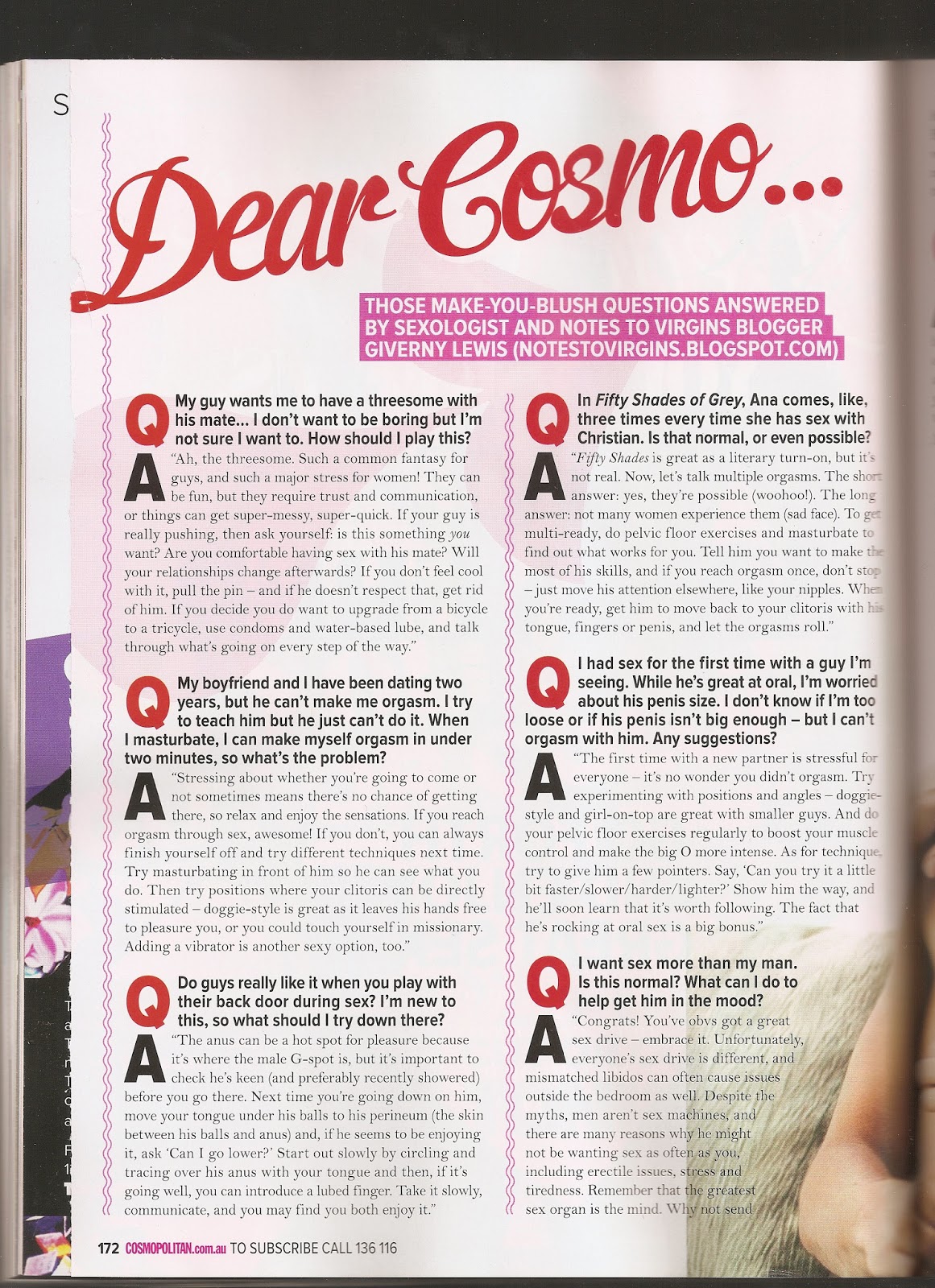
COSMO ARTICLE (June Issue)

I recently wrote a Q&A section for Cosmo magazine. Quite a few people have asked me for a copy of it, so here it is. It looks like I'll be contributing to Cosmo more often, so look out for more Q&As - and if you have any questions of your own, feel free to ask them in the comments section of this post.


Thursday, 11 April 2013

Fore & Against: Foreskin 101 (probs NSFW)


I’m passionate about foreskins. I think they’re a wonderful, sensitive and multipurpose part of the genitals which are severely underrated and misunderstood. If I could, I’d request foreskins for all. I’d give them as birthday presents and leave them in stockings for people at Christmas (too far?). But, I’m going to leave aside the moral debate about circumcision and focus on the practical and sexual aspects, to give some ideas on what to do (and what not to do) to both cut and uncut guys:

What is the foreskin?
The foreskin is a natural part of the penis. It is basically a double-layered fold of skin that covers and protects the head (glans) of the penis and urethra. It extends beyond the head when the penis is flaccid, and usually retracts to expose the head when the penis is erect. It is comparable to the clitoral hood (the small piece of skin which covers and protects the clitoris) in females. It’s very elastic and movable but, like the clitoral hood, is connected to the glans by a small piece of skin called the frenulum. The foreskin has heaps of specialised sensory nerve endings and erogenous tissue, making it super sensitive and it provides a ‘gliding’ action over the penis, which can make intercourse and other stimulation smoother and more enjoyable for all involved. 

What is circumcision?
Circumcision is a medical procedure in which the foreskin is separated and cut from the penis. It is most commonly performed on baby boys before 3 months of age, usually for religious or cultural reasons.


Goods & Bads of Circumcision
Leaving aside the moral debate around whether routine circumcision of babies is the right thing to do or not (because that gets real heated, real quick), here are a few extra things to think about:

HIV risk: Circumcision has been found to be a good, affordable option in the fight against the spread of HIV in Africa and other countries with high HIV rates, although not necessarily more affordable than condoms (and definitely not as effective). For developed countries such as Australia, the UK and the USA, condoms are still the best way to reduce the chances of HIV transmission, and routine circumcision has very little impact.

STIs: As for other sexually transmissible infections, there is some evidence that circumcised men are at lesser risk of getting these nasties, but this is also inconclusive. Your best protection will be condoms and lube.

Sexual Function: Being circumcised at an early age does not necessarily an impact on sexual function, but there may be some differences in sensitivity between those who are cut and those who are uncut. When the foreskin is removed, the glans of the penis is constantly exposed, and therefore becomes somewhat more desensitised to touch and feeling. This can have an impact on how you or your male partner likes to be touched – how firm or soft, how fast or slow, how much lube is required – so keep communicating and find out what works for the both of you.

What to do with cut/uncut guys
You might be a bit scared the first time you see a cut or uncut penis, depending on what you’re used to. For both types, there are a few things to remember and some tips to make the most of whatever he’s got going on:

CUT:
Lube it up: The foreskin provides a natural ‘gliding’ movement for the penis, so without it you’ll need a bit of help – use plenty of water based lube to stop the friction getting out of control and reduce irritation. It’ll also be more comfortable for the receiving partner, and flavoured lubes can be awesome for oral sex.

Hold on tight: Be firmer with his penis. And I don’t mean getting all 50 shades on him, but think about the reduced sensitivity he may have, and get into it. If you’re giving oral sex, incorporate your hands to make sure it’s firm enough. Check in with him to ask if he wants it firmer/looser, harder/softer, or slower/faster and change your style accordingly.

Scar tissue that I wish you saw: Each guy that’s been circumcised is left with some amount of scar tissue, usually around the side of the penis where the ‘frenulum’ would have connected to foreskin to the glans. For some, this will be a spot which has little to no feeling, but for others it will be a particularly sensitive spot.

UNCUT:
Keep it clean: Cleanliness really is the key here, and is one of the most common arguments used for circumcision (“it’s cleaner”). Without regular washing, a build-up of white/yellowish creamy discharge called smegma can build up, which is perfectly normal but may cause a strange smell, taste & irritation. There are many simple ways to keep the penis healthy, and a quick shower is really a great start. Pull the foreskin back gently and run mild, soapy water over the head and shaft of the penis, to get it in tip-top shape. Or, just have a shower together before you get down to it. Any excuse.

Start slow: Because the head/glans of his penis is all snug and protected inside the foreskin most of the time, take it slow until you’ve worked out how sensitive he is under there – some guys will be super sensitive and won’t like to be touched too directly, while others will require some more intense stimulation. Suss it out before you dive right on in.

Use the foreskin: As the foreskin is full of sensory tissue and nerve endings, use it in a few different ways for maximum awesome. Don’t be afraid to play with it, gently tug on it, hold it in your mouth, and slip your tongue inside it. It’s usually so sensitive all over, it’s a shame to waste it. But, as always, try to work out if your partner wants you to go further or isn’t enjoying it – if you’re not able to talk about it, check to see if he’s squirming or pulling away or whether he seems to be enjoying it.
The bottom line is: penises are great, and all are different. Some people have preferences about whether they like their partners to be cut or uncut, but that's a very personal decision and one which is usually based on experience, rather than functionality or truth. We also don't see a wide variety of penises in porn or sex ed (which, let's be honest, is about the extent of most of our learning about human sexuality), so we don't know what's "normal" or what we "should" look like or enjoy. Although I might sound like a broken record sometimes, regardless of whether your partner has a foreskin or not, just communicate with each other (in whatever way works for you) and you'll find a way to bring max. pleasure & awesome sex to you both.